
IT

The Indian IT Job Market: Past, Present, and the Future (2026 and Beyond)

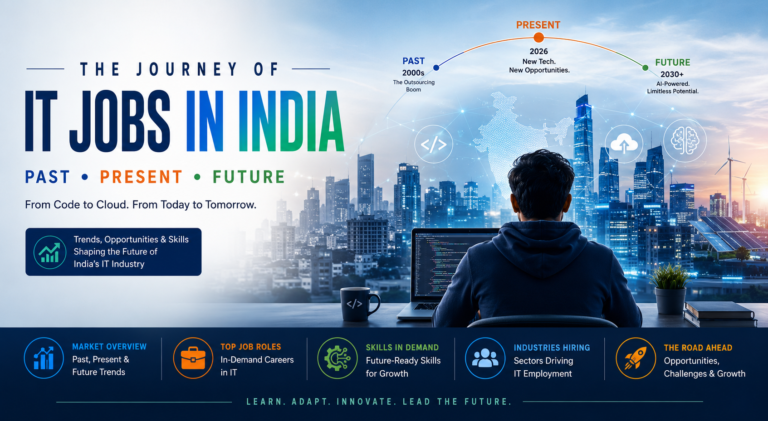
India’s Information Technology (IT) industry has long been a pillar of the country’s economy. From the outsourcing boom of the early 2000s to today’s AI-driven transformation, the sector has continuously evolved. While the market has experienced hiring slowdowns in recent years, new technologies are creating fresh opportunities for skilled professionals. The future belongs to those who can adapt, learn, and embrace change.

The Golden Era of IT Hiring (2015–2022)

Between 2015 and 2022, India’s IT sector witnessed rapid growth driven by digital transformation, cloud computing, mobile applications, and enterprise software development. Companies such as TCS, Infosys, Wipro, HCLTech, Accenture, Capgemini, Cognizant, and Tech Mahindra hired thousands of graduates every year.

During this period:

  • Massive campus hiring became common.
  • Software developers, Java developers, .NET developers, and QA engineers were in high demand.
  • Startups expanded rapidly, creating opportunities in web and mobile development.
  • Salaries increased steadily due to strong demand for skilled professionals.
  • The COVID-19 pandemic accelerated digital adoption, resulting in one of the biggest hiring booms in IT history.

Many professionals switched jobs every one to two years for better compensation, and companies competed aggressively for talent.

The Slowdown (2023–2025)

After the hiring boom, the industry entered a correction phase.

Several factors contributed:

  • Global economic uncertainty.
  • Inflation and recession concerns in the US and Europe.
  • Reduced IT spending by international clients.
  • Mass layoffs by global technology companies.
  • Increased focus on cost optimization and automation.
  • Growing use of Artificial Intelligence tools for software development.

Freshers faced fewer campus placements, while experienced professionals encountered longer hiring cycles and more competitive interviews. Companies became more selective, prioritizing practical skills over academic qualifications.

The Current IT Job Market (2026)

The Indian IT sector is now recovering with a stronger focus on quality hiring rather than mass recruitment.

Current hiring trends include:

  • AI-assisted software development.
  • Cloud computing.
  • DevOps and Site Reliability Engineering (SRE).
  • Cybersecurity.
  • Data Engineering.
  • Artificial Intelligence and Machine Learning.
  • Full-stack development.
  • Product engineering.

Recruiters increasingly evaluate:

  • Real-world projects.
  • Problem-solving ability.
  • Understanding of software fundamentals.
  • GitHub portfolios.
  • Communication skills.
  • Practical coding knowledge.
  • Familiarity with AI development tools.

Companies now expect developers to use AI responsibly while maintaining a solid understanding of algorithms, system design, and software engineering principles.

Skills Most in Demand

Software Development

  • Java
  • Spring Boot
  • Python
  • .NET
  • Node.js
  • React
  • Angular
  • PHP
  • Go

Cloud & DevOps

  • AWS
  • Microsoft Azure
  • Google Cloud Platform
  • Docker
  • Kubernetes
  • Jenkins
  • Terraform
  • Linux
  • GitHub Actions

Data & AI

  • SQL
  • Power BI
  • Apache Spark
  • Hadoop
  • Machine Learning
  • Generative AI
  • Large Language Models (LLMs)
  • Prompt Engineering

Cybersecurity

  • Network Security
  • Ethical Hacking
  • SOC Operations
  • IAM
  • Cloud Security

Industries Driving Hiring

IT jobs are no longer limited to software companies.

Hiring is increasing across:

  • FinTech
  • HealthTech
  • EdTech
  • E-commerce
  • Travel & Hospitality
  • Manufacturing
  • Automotive
  • Banking
  • Logistics
  • Government digital transformation projects

The Role of Artificial Intelligence

AI is changing software development rather than replacing developers.

Modern engineers use AI for:

  • Code generation.
  • Debugging.
  • Documentation.
  • Unit test creation.
  • Code optimization.
  • Learning new technologies.

However, employers still expect engineers to understand:

  • Data Structures and Algorithms.
  • Object-Oriented Programming.
  • Database design.
  • Software architecture.
  • System design.
  • API development.
  • Security best practices.

Developers who rely solely on AI without understanding the underlying concepts often struggle during technical interviews.

The Future of IT Jobs in India (2027–2030)

The outlook for India’s IT sector remains positive.

Expected trends include:

  • Continued growth in AI and automation.
  • Expansion of Global Capability Centers (GCCs) in India.
  • Increased investment in cloud infrastructure.
  • Greater demand for cybersecurity professionals.
  • More opportunities in SaaS product companies.
  • Higher demand for AI engineers, DevOps engineers, data engineers, and cloud architects.
  • Increased adoption of remote and hybrid work models.

Industry experts expect India to remain one of the world’s largest technology talent hubs due to its large engineering workforce and expanding digital economy.

Tips for Job Seekers

To stay competitive:

  • Build strong programming fundamentals.
  • Create real-world projects and maintain a GitHub portfolio.
  • Learn cloud platforms such as AWS or Azure.
  • Understand DevOps tools and CI/CD practices.
  • Practice coding regularly.
  • Learn SQL thoroughly.
  • Improve communication and interview skills.
  • Use AI tools to enhance productivity, not replace learning.
  • Stay updated with emerging technologies.

Conclusion

India’s IT industry has evolved from an outsourcing powerhouse into a global technology innovation hub. While the era of easy mass hiring has ended, opportunities remain abundant for professionals with practical skills, adaptability, and a willingness to learn. The future belongs to engineers who combine strong technical fundamentals with AI-assisted productivity, making continuous learning the key to long-term career success.

I

Impactnests

Writer at ImpactNests covering opportunities and sustainability.

Join the conversation

Share your thoughts — we’d love to hear from you.

Leave a comment

Your email address will not be published.

Keep reading

Related Articles